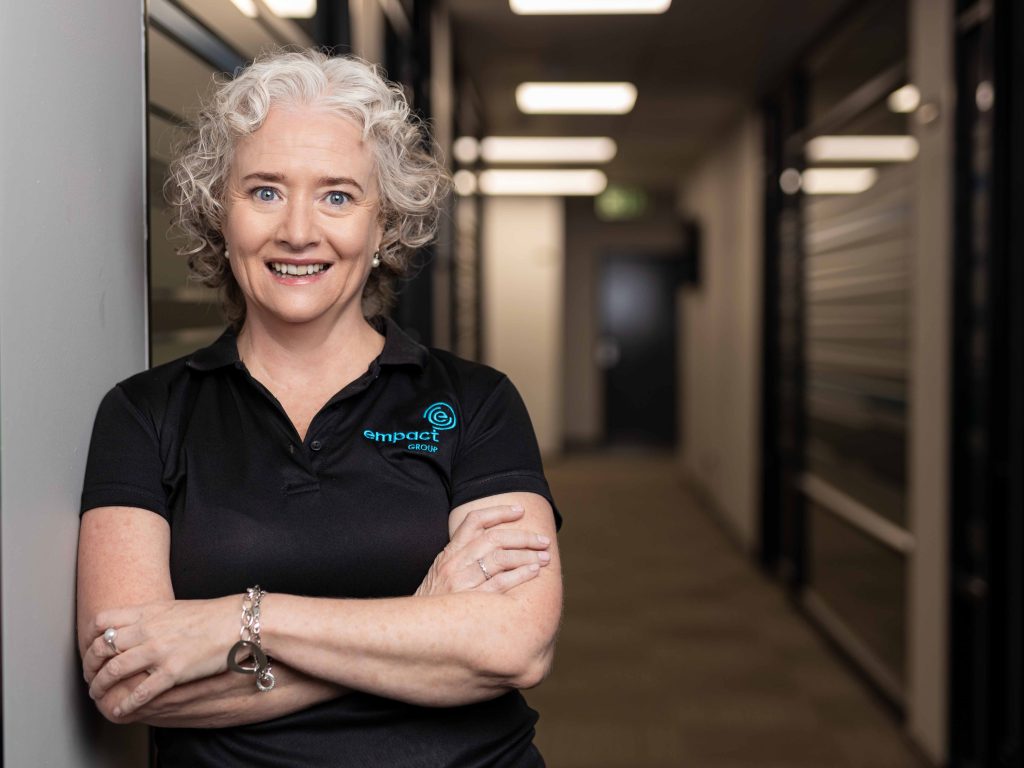
Empact Group Sustainability executive, Lara Barlow.
Empact Group published its first Sustainability Report earlier this year, in which it also noted that it is the first South African services company to sign up to the voluntary corporate climate organisation Science Based Targets Initiative (SBTi).
The catering, cleaning and facilities management company is also part of the South African Food Loss and Waste Initiative.
ESG Global sent three clever questions to Group Sustainability executive Lara Barlow to find out the reasons behind committing to the SBTi, employee empowerment and the socio-economic transformation of its supply chain.
What was the foremost reason behind Empact signing up for the SBTi?
At the heart of our decision to register with the SBTi is accountability. We have made bold commitments — a 40% reduction in combined Scope 1 and Scope 2 emissions by 2035 and carbon net-zero by 2050 — and the SBTi gives us the scientific framework to ensure those targets are credible and externally validated rather than self-declared.
We have already achieved a 14.7% overall reduction in emissions since our 2022 baseline, which gives us confidence that our direction is right. Submitting our targets for SBTi validation by 2027 is about ensuring that our commitments stand up to rigorous scrutiny and that our progress can be measured transparently against globally recognised standards.
How has Empact tangibly influenced the holistic well-being, development and empowerment of its employees?
We employ over 25 000 people, many of whom face very real socio-economic pressure. During the past financial year, 17 317 employees received training across learnerships, management development and professional skills programmes. We have introduced Paymenow, which gives employees access to a portion of their wages before payday and reduces reliance on informal and often predatory lending, and Randgo, which helps employees save up to R750 per month on household essentials. Our annual Wellness Day connects people with health, nutrition and financial support, and our National Women’s Day event is particularly meaningful as over 70% of our workforce is female. The event creates a safe space for recognition, empowerment and support around issues like gender-based violence. Employee satisfaction has risen by 21.4% since 2019, representing is a shift in how our people feel about coming to work every day.
Our commitment to employee safety needs special mention. To our knowledge, no other organisations outside of the mining and gas sectors implement the kind of measures Empact follows in terms of employee safety. Our safety team raises awareness of any incident that occurs within the business. All of these daily reports are a message of care and focus on what went wrong, what went well and how it can be prevented in the future.
How is Empact using its supply chain as a vehicle for social and economic transformation?
Our supply chain represents one of the most powerful levers we have for creating lasting social and economic change. We direct 51.3% of our annual supplier spend towards organisations that are more than 51% black-owned, of which 43.4% goes to black female-owned enterprises, because we believe inclusive procurement is a deliberate choice to build a more equitable economy.
Through our supplier development programme, we have provided start-up capital, equipment, training in food safety and occupational health, and structured mentorship to businesses like Queen’s Bakery in Thabazimbi and Khayelitsha Cookies. Empact now spends over R6 million per year with Khayelitsha Cookies alone, which today employs close to 100 women from under-resourced communities and produces over 80 000 handmade cookies daily.
Within our Facilities Management division, local employment through our supplier partnerships has grown from 119 to 622 individuals over the past decade. These statistics represent families supported, livelihoods created and communities strengthened. For us, the supply chain is a direct expression of who we are and the future we are working to help build.
 Subscribe to ESG Global newsletter