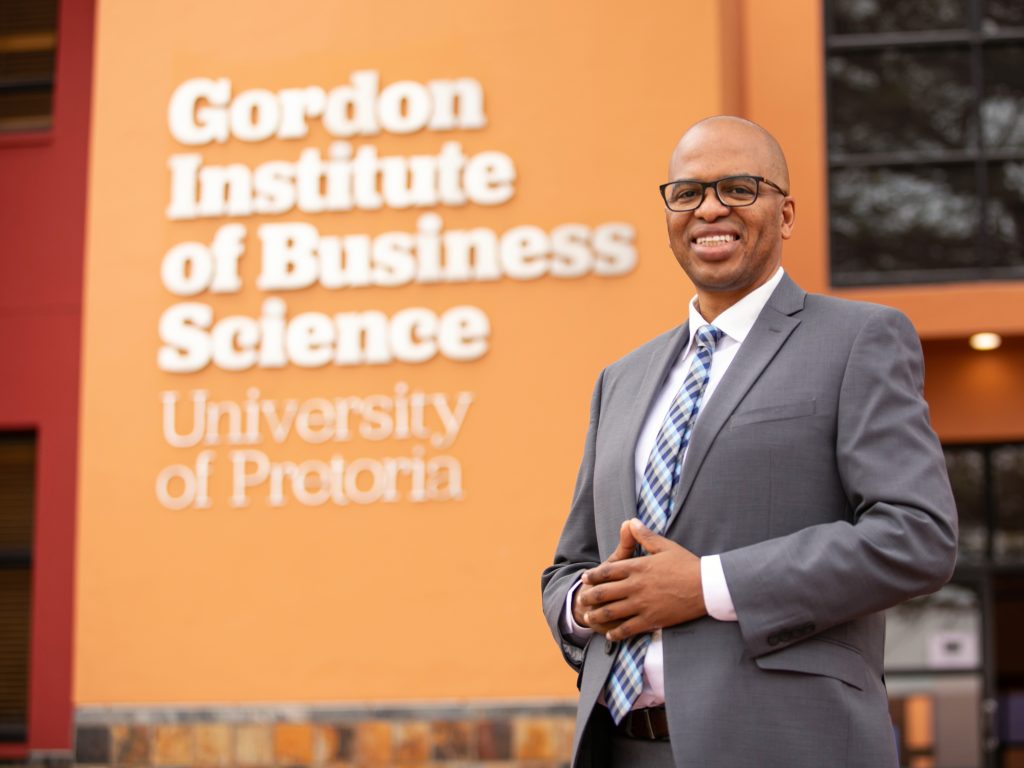
University of Pretoria’s Gordon Institute of Business Science Dean, Professor Morris Mthombeni.
The University of Pretoria’s Gordon Institute of Business Science (GIBS) has been awarded an AA rating in CEO Magazine’s 2026 Green MBA Index, which evaluates business schools on how effectively they incorporate ESG principles and sustainability into management education.
It is now the only business school in Africa, among the 13 institutions globally, to have received such a rating.
ESG Global sent professor Morris Mthombeni, dean of GIBS, three clever questions about personal sustainability practices, local context and the school’s own carbon footprint.
What’s something in your own life that you’re still working on in terms of sustainability?
Sustainability for me is as much about behaviour as it is about policy. I’m still working on embedding more sustainable habits into my daily routine, particularly around consumption and resource use.
Whether it’s printing only when necessary, avoiding unnecessary purchases, or resisting the urge to replace items before they’ve reached the end of their useful life, I’m becoming more intentional about my choices every day.
I’m also mindful of the influence we have on those around us, so I try to encourage others to consider how small, consistent actions can contribute to a more sustainable future.
What does an AA rating on the 2026 Green MBA Index mean in a South African context?
It signals that the school is operating at a globally recognised level of sustainability integration in management education, rather than simply offering ESG as a standalone module. The rating reflects strong performance across key dimensions, including curriculum integration, experiential learning, research and thought leadership, institutional practices, and graduate outcomes.
How has GIBS’ own carbon footprint been managed, since ESG has incorporated into the curriculum?
Since embedding ESG and sustainability more deeply into our curriculum and strategy, GIBS has taken a number of practical steps to manage and reduce its own environmental footprint.
The school has tracked its carbon footprint for several years, with independent audits currently conducted by Brundtland Consulting, and formally established a carbon emissions baseline in 2022 to support measurement and accountability. Climate leadership is now a strategic priority, reflected in operational initiatives such as generator synchronisation to reduce fuel consumption, energy audits to identify efficiency opportunities, and the planned implementation of a substantial solar energy project.
GIBS has also reduced emissions, strengthening waste management through recycling programmes, like the recycling of used cooking oil, biodegradable consumables, and the conversion of food waste into fertiliser on campus.
In addition, the IT department manages the responsible disposal and recycling of obsolete electronic equipment and e-waste, ensuring environmentally sound handling of technology assets.
Water conservation measures include the installation of air-assisted toilets, which use only 1.35 litres per flush and can reduce water consumption by up to 85%, contributing to lower water, energy and carbon impacts.
Collectively, these initiatives demonstrate GIBS’ commitment to ensuring that its sustainability ambitions are reflected not only in the classroom but also in its day-to-day operations.
 Subscribe to ESG Global newsletter